While speaking at the Barnes and Noble in Madison, Wisconsin, several in the audience had surprised expressions when I gave statistical information about medication and epilepsy. For many, it is shocking to hear that after the first medication fails to control seizures, there is less than a fifty percent chance the second medication will work. After the second medication fails, there is less than a twenty percent chance that medication will ever control seizures. If we knew this information going into that first doctors appointment, would it change the treatment plan for seizures? I hope so.
As recommended by Epilepsia (a publication for neurology professionals) after the second medication fails, the ketogenic diet should be tried. The ketogenic diet carries less risk than any drug on the market, and has a proven track record of nearly one hundred years. So why are so few kids and adults prescribed *dietary therapy for seizure disorders?
Knowledge. The answer to the question above, is simply lack of knowledge and understanding of the diet by medical professionals who treat seizures. In the 1950's when anti-seizure medications were developed, the diet became prehistoric in a sense. Most thought the answer to seizure control was here; but it hasn't arrived for more than forty percent, of the three million Americans who suffer with epilepsy.
If you are the parent of a child that has uncontrolled seizures, and are considering dietary therapy, take the above statistics with you the next time you visit the doctor. When you know the facts, and are aware of all the treatment options, it's easier to make a confident decision. Become empowered.
*Dietary therapy for seizures includes, the ketogenic diet, modified atkins diet, or low glycemic diet.
Sunday, July 10, 2011


Thursday, April 28, 2011
Interview at Noon

One of the blessings of getting a book published is that it has given me a platform. A platform to share what I've learned through our journey with seizures and autism, and the ability to support others on their own journey.
On Friday, April 29th at noon in Madison, Wisconsin, on channel 3, I will be interviewed by Madison's own Charlotte Deleste. I'm never sure when an interview is planned what questions will be asked, but no matter what, every time there is the opportunity to share our story and the miracle of the ketogenic diet, there is also the possibility that it might help another child. Being informed is to be empowered.
If you live in the Madison, Wisconsin area, please tune in to WISC-TV channel 3 on Friday at noon; and you are also warmly invited to join us as we continue to spread awareness for seizures and autism at Barnes and Noble Madison stores on Saturday, April 30th.
*Please note poster to the left for more detailed information.
*Please note poster to the left for more detailed information.
Friday, April 15, 2011
Quarter for a Clear View
It was intentional. The view finder (click here to see as shown on the blog page) was given much thought prior to being chosen as the face of this blog. At first glance it's a bit of a nostalgic, touristy kind of photo, but when I read the instructions on the view finder; the wording, "turn knob for a clear view" caught my attention, and in its own way, mirrors the message of empowerment contained in this blog.
Wouldn't it be great if when we first heard the words, "something isn't right" all we would have to do is pay a quarter, crank a knob, and viola! A manual with instructions would appear; with all of the treatment choices available. Our vision would be clear! We would have all the information to make informed decisions to best help our child or loved one. No more trying to unlock a door from the pile of a thousand keys, or trying to solve a puzzle with many of the pieces missing. Just drop a quarter--wouldn't that be something?
When Christina was diagnosed at seven months with epilepsy, we tried every anti-seizure drug and had every test. No answers as to why the seizures started and worse yet, we could not stop the seizures. An even greater tragedy however, that affects hundreds of thousands of children, is the lack of disclosure and lack of knowledge by those responsible for our children's medical care. In fact, when we stumbled upon another treatment option and inquired about it, the neurologist told us it was not safe for small children. We believed this. Who wouldn't? This was a neurologist, highly regarded in the community, and we trusted him.
Desperation set in when we almost lost our beautiful daughter after several more months of life-threatening seizures. With no treatment options left, and we took a leap of faith and traveled twelve hundred miles to Mayo Clinic. Within days of administering the diet there, the seizures stopped.
When the dust settled we realized that advocacy turned the tables for our child.
Dr. Jeffrey Buchhalter wrote in the forward of Good Morning, Beautiful:
In order for our vision to be clear, we must step up and take on the responsibility for our child or loved one's care. We are advocates. And even though it may seem overwhelming at times, you will get through it. If I can, anyone can. Mother Theresa once said, "I know God will not give me anything I can't handle. I just wish He didn't trust me so much." Can't tell you how many times, I felt this same way, but through it all, the greatest success was found in never giving up.
For a listing of facilities that provide second opinions and great ketogenic and autism care, click here.
Wouldn't it be great if when we first heard the words, "something isn't right" all we would have to do is pay a quarter, crank a knob, and viola! A manual with instructions would appear; with all of the treatment choices available. Our vision would be clear! We would have all the information to make informed decisions to best help our child or loved one. No more trying to unlock a door from the pile of a thousand keys, or trying to solve a puzzle with many of the pieces missing. Just drop a quarter--wouldn't that be something?
When Christina was diagnosed at seven months with epilepsy, we tried every anti-seizure drug and had every test. No answers as to why the seizures started and worse yet, we could not stop the seizures. An even greater tragedy however, that affects hundreds of thousands of children, is the lack of disclosure and lack of knowledge by those responsible for our children's medical care. In fact, when we stumbled upon another treatment option and inquired about it, the neurologist told us it was not safe for small children. We believed this. Who wouldn't? This was a neurologist, highly regarded in the community, and we trusted him.
Desperation set in when we almost lost our beautiful daughter after several more months of life-threatening seizures. With no treatment options left, and we took a leap of faith and traveled twelve hundred miles to Mayo Clinic. Within days of administering the diet there, the seizures stopped.
When the dust settled we realized that advocacy turned the tables for our child.
Dr. Jeffrey Buchhalter wrote in the forward of Good Morning, Beautiful:
When a family confronts a medical care environment that fails to meet the needs of the child or parents, what can they do? As one who has devoted his professional life to the care of children with epilepsy, I can tell you that this occurs not out of lack of concern on the part of health care providers, but lack of expertise and familiarity. This book shares the journey of how one family learned what they could do. Its intent is to impact others' lives and inspire them to do the same as families must assume responsibility for care.
In order for our vision to be clear, we must step up and take on the responsibility for our child or loved one's care. We are advocates. And even though it may seem overwhelming at times, you will get through it. If I can, anyone can. Mother Theresa once said, "I know God will not give me anything I can't handle. I just wish He didn't trust me so much." Can't tell you how many times, I felt this same way, but through it all, the greatest success was found in never giving up.
For a listing of facilities that provide second opinions and great ketogenic and autism care, click here.
Monday, March 14, 2011
Development of The Ketogenic Diet
I've heard it said that history is one of our best teachers. This realization hit hard for me while doing research in a hospital library. Tears blurred the pages and painful emotions tore at me from the deadly diagnosis the neurologist had announced earlier. I was desperate to save my child. Foreign medical jargon and terminology beyond my education inked the pages, but even so I understood enough to know we hadn’t been given all the treatment options. Why?
At the library that day, I read about a diet, developed in the 1920s, that stopped seizures in children. Dr. R.M. Wilder, a diabetologist, and his team at the Mayo Clinic had been working to stop seizures in diabetic children. This research had actually started four hundred years before Jesus walked on Earth by a physician named Hippocrates. Hippocrates believed in healthy eating to heal our bodies. His research on epilepsy included dietary intervention and fasting for kids with seizures. In addition to that, a story in the New Testament, chronicled by Matthew and Mark, told of a boy with epilepsy who was healed by Jesus. "This kind of healing comes from fasting and prayer" (Mark 9:29 NIV).
Inspired by the studies and writings mentioned above, Dr. Wilder prescribed fasting for diabetic seizure children. Do you think he was surprised when many children stopped seizing? It's just my hunch, but I think he expected it. Who wouldn't if the history is taken seriously. Either way, Dr. Wilder then took chemical components in the blood and urine and formulated a diet that simulated the same. In other words, they developed a diet that mimicked fasting--and it worked. The diet was named Ketogenic after the ketones we measure when our body burns fat. The diet was used with great success until the 1950s when anti-seizure drugs were invented, then became prehistoric in a sense. Today we know that thirty to forty percent of patients don't respond to medication. Shouldn't we question whether we should be taking a look back in time?
The answer to the above question of why doctors don't always prescribe the diet is alarming: many simply don't believe the diet works. Some cite it's too complicated (a diet--too hard?). Others simply don't know much about it, or they simply don't have a dietitian trained in administering it. For our family, we felt as though information had been withheld and our daughter's life had been put at risk by not being informed of all the treatment options.
During a speaking event in Madison, Wisconsin, two women marched in with copies of Good Morning, Beautiful tucked in their arms. As tears streamed down one of the women's cheeks, she took my hand in hers and told me how proud she was of me. I was certain her grandchild or child was on the diet, but I was wrong. "I was the one," she exclaimed. In the 1950s, when all medications failed, she was put on the ketogenic diet and it saved her life. She reminisced about her doctor, stating he was old enough to remember the diet's discovery and smart enough to use that information to spare her life.
Thursday, February 24, 2011
New Series begins today!
Today begins a new series of postings crafted to inform, inspire, and empower.
First, it's important to start with the facts (the informing part), so here they are:
- In America there are three million people living with seizures and epilepsy.
- Every year another two hundred thousand more cases are diagnosed--the majority are children.
- Thirty to Forty percent of all who have epilepsy have intractable (unstoppable) seizures, meaning they are not able to be controlled with medication. It's also interesting to note that of children diagnosed with autism, Thirty to Forty percent also have intractable epilepsy, and that statistic is climbing.
The first day of February, 1998, our seven-month-old daughter became one of the nearly two hundred thousand diagnosed that year with epilepsy. We soon learned there wasn't a manual that came with this diagnosis.
Before long my journal was etched with prayers and painful sagas of medication trials that didn't stop the relentless seizures. It felt like a torrential storm that wouldn't dissipate until we learned of a diet that stops seizures. We did not, however, learn about it from the doctor.
Next post (the inspiring part) will contain details about the diet, its amazing roots, and why it isn't prescribed by most doctors.
Tuesday, February 15, 2011
Another twitter account violating my blog!
My twitter updates are linked to this blog, but somehow, another twitter account is violating my space! Inappropriate twitter updates have replaced mine. I don't know how this is happening, but apologize if you have have come across them.
If you read twitter updates that contain vulgar or inappropriate content, please know it is not my twitter account making these updates! I've requested help from twitter and blogger and hope the problem is taken care of.
In the meantime, please email me if you read any posts that contain anything other than a G rating to paulette.gmb@gmail.com.
Thank you for your understanding.
If you read twitter updates that contain vulgar or inappropriate content, please know it is not my twitter account making these updates! I've requested help from twitter and blogger and hope the problem is taken care of.
In the meantime, please email me if you read any posts that contain anything other than a G rating to paulette.gmb@gmail.com.
Thank you for your understanding.
Monday, November 15, 2010
When the last post was created, it was written with the thinking that this next blog would follow soon after. However, life changed for us with the onset of another seizure and the realization that we were back in the battle again. Now that we've adjusted, the quest continues to remain seizure free and my duties as a blogger continue. Please accept my apology for taking so long to complete "the rest of the story" as Paul Harvey would say.
The first morning of the International Christian Retail Show in St. Louis, Larry had planned to drop me off to meet with my publisher and the media, then take the kids out to breakfast. Our plans came to a sudden halt when Mathew called for me in a serious tone. Something was wrong with Christina. She was limp and unconscious, lying on the hotel room bed.
Larry called 911 and I positioned Christina in my arms and held her head. At first my mind couldn't wrap around what was happening. A stroke? Did she hit her head? The idea that she could be having a seizure‑it had been eight-and-a-half years‑entered my mind last along with the thought, This cannot be happening!
Two stern paramedics arrived five minutes after the call. As they walked down the hotel hallway, Mathew waved them on to our room. Christina was still, limp, and her breathing was shallow. We didn't know this at the time, but when Mathew was waving for the paramedics, a hotel employee overheard one of the paramedics mumble, "She's only having a seizure!" as if the inconvenience of hurrying was uncalled for.
As they put Christina into the ambulance and were working on her, I called my friend Betsy and asked for prayer. She immediately emailed everyone in our prayer group. Then, I phoned my publisher, Tim, and explained what was happening. The Ambassador team went into prayer for us as well.
Wednesday, September 1, 2010
The Fable of Failing to Thrive
As promised in my last post, I will share two things that happened while we were in St. Louis for the International Christian Retail Show.
When I wrote chapter ten, which is titled, “The Fable of Failing to Thrive,” I did so thinking that what I wrote about would never happen again. After all, Larry and I now knew better how to handle our daughter's medical care and avoid critical mistakes. What we didn't expect was that this degree of egotism—which has an unhealthy habit of accompanying us humans—would wreak havoc during a crucial time this summer. In fact it placed Christina's well-being at risk and threatened to have my husband and me arrested. True story.
In order to understand what happened this summer, the story needs to be told from the beginning. An excerpt from chapter ten of Good Morning, Beautiful is below. This is where it all began.
When I wrote chapter ten, which is titled, “The Fable of Failing to Thrive,” I did so thinking that what I wrote about would never happen again. After all, Larry and I now knew better how to handle our daughter's medical care and avoid critical mistakes. What we didn't expect was that this degree of egotism—which has an unhealthy habit of accompanying us humans—would wreak havoc during a crucial time this summer. In fact it placed Christina's well-being at risk and threatened to have my husband and me arrested. True story.
In order to understand what happened this summer, the story needs to be told from the beginning. An excerpt from chapter ten of Good Morning, Beautiful is below. This is where it all began.
Christina was losing weight fast and quickly looked thin and pale, becoming lethargic. She seldom moved. She reached a critical state of dehydration that was not reversed by the IV solution. It didn’t make any sense. Since being on the ketogenic diet she had become a good eater. Why, for seemingly no reason, would she stop eating?
Twenty-four hours after being admitted—she seized, wriggling herself to a sitting position before falling over. I could hear the metal crib rattle and shake as her head fled into the mattress. Rushing to her side, I lowered the crib and lifted her face from the mattress, positioning her in my hands. Thick tears streamed down drawn little cheeks giving way to an unnatural smile. It was a dark intense seizure that rolled in without warning. More intense than before, her seizures came in sets or series sometimes only minutes apart—more than 100 per day.
Three days after being admitted, most of the results were back negative for any kind of infection or disease. Confused that there was nothing to treat, the head nurse sat on the floor Indian style, with Christina. She dropped droplets of formula into the little clenched mouth of Christina, but she refused to swallow.
“I don’t understand why we cannot get her to eat. Have any of the test results come back in yet?” I asked.
She shook her head. “So far nothing has come back positive.”
“Have you ever seen anything like this before?” I asked.
“Well, I’ve seen this in infants who fail to thrive,” she answered.
I was afraid of even knowing what that meant, but had to ask. She explained it as a neurological condition where children give up the will to live—they stop eating—they stop surviving.
Thoughts raced: after all little Christina had been through, could she be giving up the will to live? Could my precious little one be refusing to eat or live? The visit with Dr. Gomez flashed in my mind; he had been positive about everything. Did we miss something?
Already mistrustful because of previous misinformation, I was not so sure what to think of this revelation. In a way, I was irritated with this nurse for so easily giving such a fateful opinion. Still, the question kept coming back to me again and again: What about the other symptoms? What about the constant diaper changes and throwing up? I was fearful of what might be causing it. Could there be a genetic disorder, or a cancer, that had been missed?
When Dr. Gomez returned my phone call, I explained to him what was happening with Christina. He had already reviewed the notes from Susan but he wasn’t expecting all this.
“What does the doctor think she has? She must have something to make her not want food,” he said simply.
I explained that they were running tests and I would call as soon as results were in. Then I told him that if she needed to be hospitalized for a longer period we wanted to fly her into Rochester and transfer care to Mayo Clinic. He seemed hesitant at first, stating that Christina could not fly until she was hydrated, it would be dangerous for her. Since the return of the seizures, I wondered: When food isn’t eaten shouldn’t the body be in a state of real fasting. Why, then, were the ketones so low and seizures back?
“Without eating, shouldn’t they be high like before?” I asked curiously.
“What—?” He paused awkwardly then spoke, “What kind of fluids are they giving her?”
I followed the tubing up to the IV bag held by the steel loop n top of the stand and read the black print: “D-e-x-t-r-o-s-e, it says dextrose.”
A slight grunt and gumble was heard through the phone, then silence. “It’s too late now,” he broke in disappointedly.
Dr. Gomez explained that the IV fluid given was wrong, because dextrose is sugar. It stopped the ketosis Christina was in. The seizure freedom was over, due to an unnecessary mistake. The apprehension in his voice about bringing her back to Mayo subsided.
“She needs to be hydrated before traveling here, that’s first. Then I want her to eat. If she won’t eat on her own, they need to tube feed her. Is that clear?” He was short and to the point. “Call me when she is ready and I will make preparations for her to be admitted.”
Anger ripped through me. Did this hospital even care?
A flustered nurse ran to get the doctor when I pointed out the mistake. I felt as though he had let us down—let Christina down. When he arrived through sobs I told him just that and more: He didn’t keep his promise about making sure the diet would be followed—even though the instructions right down to the IV fluid had been faxed over by Susan. Shaking his head in disappointment, he agreed to order the feeding tube, and left to do so.
With relentless seizures back, Larry and I again tried to balance. … I pressed the nurses’ call button, and waited for 20 minutes. If it weren’t for Whitney being there, I would not have been able to unwind the tubing and lift Christina safely out of the crib. When the nurse finally came in, I unloaded frustration at the hospital that seemed to fail us. “No one here seems to care!” I reminded her about the wrong IV fluid.
“But, we needed to get her hydrated,” she defensively answered.
“There might be a reason she isn’t eating.” She didn’t say the exact words the other nurse had, but I knew she meant “failure to thrive.”
That night I couldn’t sleep and listened to Mathew’s soft breaths as he slept near Whitney on large cushioned mats and blankets on the hospital room floor. Inches away, Christina’s crib sat empty. She had fallen asleep in my arms exhausted from the day’s run of seizures. My mind wouldn’t quiet enough to rest, is our daughter failing to thrive—will she survive this? I prayed God would once again give me direction and help us to help Christina.
Thirty-six hours later, with a frustrated tone, Dr. Gomez asked why the feeding tube had not yet been placed. He was pensive and I wondered if he was angry when he said, “I’m sorry you are having trouble. But, please, give the doctor in charge this message: "Feed the baby!”
By the time Larry arrived that evening I had been to the nurses’ station several times pleading for a feeding tube. Finally, Larry sternly threatened going to hospital administration. Not long after, a nurse and dietician arrived with a portable pump and equipment for tube feeding. After inserting the tube into Christina’s little nose, they wheeled her to X-ray to make sure it was placed properly and finally, the dietician brought in the formula.
“After looking over the formula, I changed the ratio,” she explained.
I was shocked that she changed something so important without asking.
“What—why would we change the formula?” I sparked.
Her inability to understand the diet was part of the reason we traveled 1,200 miles for help—and now she was insistent that the diet had been formulated incorrectly? I tried to think of words to say but decided to remain silent—no one was listening anyway.
My daughter had lost two-and-a-half of her twenty pounds—and was lying lethargic in her crib. I wanted nothing more than to feed her. After filling the portable pump with formula, the machine began to pass nutrition into Christina’s body. Early evening, Larry returned to the hospital looking wrung from a long day at the office and worry about Christina. He held a white envelope and without saying anything, he placed it in my hand. Then he picked up Mathew and gave him a bear hug. I looked at him curiously.
“Two tickets. One for you, one for Christina, and your flight leaves tomorrow. The flights were expensive, we couldn’t afford all five tickets, so I’m driving up with Whitney and Mathew. Whitney’s mom said it is okay for her to go. My brother Jim will pick you up at the airport and drive you to Rochester.”
By now, I was sick of tears, but could not fight them off.
“Are you okay?” Larry inquired.
“Do you think she is going to survive this?”
“That is why you’ll be on a plane tomorrow. …” Overcome by emotion, he stopped.
After requesting release information, the head nurse stood outside Christina’s room obviously disturbed, searching for the words, “I-I don’t know if the doctor will release her.”
Larry spoke matter-of-fact, “She is re-hydrated and per Dr. Gomez’s instructions she is getting food via the feeding tube. plans on stopping me.”
Five days after being admitted for flu like symptoms, Christina had lost two-and-a-half pounds. Her face was thin and pale, bruises from attempts at IV’s and blood draws marked her arms. A feeding tube held in place with tape ran into her nose, as we took a step of faith and headed for the elevator. I wondered if someone would try to stop us, even worried for them if they did—Larry had a look of adamancy. He was ready to take on whomever if he needed to.
My eyes burned with sleeplessness fed by anxiety, fear, and the seizures that riddled each night. What was it that was trying to take our daughter’s life? Countless blood, urine, and stool samples were taken as witnessed by numerous bruises, her weight loss evident when I held her. I fought anxiousness and tears with prayer—but struggled not to fall into the pit of despair. The nurses and doctors all had ideas of what could be causing our daughter to be wasting away, from salmonella to food poisoning to the worst of all, failure to thrive. But their theories came to nothing. We had nothing to treat—and that nothing was trying to take her life.The following was written by Jim Abrahams, Founder of The Charlie Foundation To Cure Pediatric Epilepsy. Excerpt from Good Morning, Beautiful.
The medical destiny of each of us and our
children is largely up to us. To think otherwise
can be damaging. There is a tendency when we walk into
a doctor’s office to want to hand over our problem to the doctor
and say, “Here it is, please fix it.” It’s comfortable, it’s easy, and
more often than not, it works. Just as we take comfort in deferring to
them, many doctors are unwilling to confide in us that we
may have stepped into one of Western medicine’s black
holes. There are many black holes, and they are deep, and
kids with difficult-to-control seizures are in one of them.
So what does that mean? It means that our medical
problems and our children’s medical problems are precisely
that—OURS. At first, that’s a pretty intimidating
and perhaps a seemingly foolish concept, both to us and
to some physicians. After all, they went through years of
education. They’ve seen countless patients in their practices.
And then we walk into their offices with a disease we
probably don’t even know how to spell. How presumptuous
and perhaps foolish of us, the patients, to ask and
then pursue the hard questions, learn the side effects, get
the second opinions, do the research, and participate in the
cure—in short, to become proactive.
Ironically, the “side effect” of participating in our
medical destinies may not only lead to getting better
sooner. It is empowering.
Monday, July 5, 2010
The Morning Blend and Borders
Before I begin this post I'd like to thank everyone who came to the book signing at the International Christian Retail Show in St. Louis. To our family in St. Louis, our hearts are full after spending time with you, thank you for all the love and support! It was also a blessing to meet in person the Ambassador International team, and even more so to know they are dedicated to the vision of helping people through Good Morning, Beautiful.
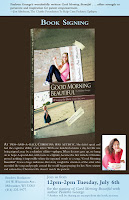 July 6th we appear on The Morning Blend show at 9:00 a.m. For those of you in the Milwaukee area, please tune in to TMJ4. We are very excited to share our story, but most excited to share in order to support others in their journey through epilepsy and autism.
http://www.themorningblend.com/videos/97407064.html
Also tomorrow we will be signing books at the Borders store downtown Milwaukee from 12 -2 p.m. Please see poster for details of this signing.
If you are the parent of a child with seizures or autism, we would love to connect with you. If you cannot make it to the signing, please don't hesitate to send me an email: paulette@paulettegeorge.net.
In the next blog post I will share details of the International Christian Retail Show, and an amazing thing that happened while attending the show, and one not so amazing thing that seemed to replay a chapter in Good Morning, Beautiful.

http://www.themorningblend.com/videos/97407064.html
Also tomorrow we will be signing books at the Borders store downtown Milwaukee from 12 -2 p.m. Please see poster for details of this signing.
If you are the parent of a child with seizures or autism, we would love to connect with you. If you cannot make it to the signing, please don't hesitate to send me an email: paulette@paulettegeorge.net.
In the next blog post I will share details of the International Christian Retail Show, and an amazing thing that happened while attending the show, and one not so amazing thing that seemed to replay a chapter in Good Morning, Beautiful.
Wednesday, June 23, 2010
Monday, June 21, 2010
The Enormous Grey Building
Tomorrow we have a book signing at the Barnes and Noble store in downtown Rochester, Minnesota. Not long after arriving in town, the kids and I took a leisurely walk near the Barnes and Noble store which is a block from Mayo Clinic. As we passed by the entrance to the Kahler Hotel, my mind flashed back to the first time we came to Rochester for Mayo Clinic and parked in front of those double doors ten years earlier. Turning toward the Mayo Building that towered across the street, I raised my hand to block the sun and looked up. That's when I began telling the story to the kids as though they had never heard it before. As I talked, Mathew lifted the camera to his eye and snapped this picture.
In Chapter nine of Good Morning, Beautiful, I wrote about that day and thought since we had this picture, you might appreciate reading about that visit for yourself.
Excerpt from Good Morning, Beautiful:
 Warm air from a clear July day brushed my face as I bent my neck back to scan the enormous grey building, home to
Mayo Clinic. The clinic hovered over us eclipsing other buildings
as we stood across the street near the entrance of our hotel, freshly arrived from a two day trip. Larry’s arms wrapped around Christina, fresh out of her car seat, the strap of a diaper bag was slung over my shoulder as I held onto Mathew’s hand. We all looked up.
The gigantic building rose into the cerulean blue sky, reminding me of the Sears Tower. Gigantic slabs of battle ship grey marble formed parts of the exterior, and a massive bronze sculpture of a man, arms stretched upward, evoking the humaneness of us all protruded from the exterior several floors up.
A uniformed bellhop came rushing out to greet us. “Can I
help you with the luggage, sir?”
“Ah—yes,” Larry answered shifting his attention away from
the building.
“It’s quite a sight, isn’t it?” the bellhop said smiling, “You here
for the clinic?”
“Yes, we are.”
Larry and the bellhop began emptying the van. Luggage, baby bottles—some needing to be washed—a box of carbohydrate free formula and another with glass bottles of microlipid (fat emulsion). They clinked together as they were lifted on to the luggage carrier. When the men finished, only two car seats and Cheerios scattered on the car’s carpeting were left.
Burgundy and gold carpet rolled across the reception area floor distracting the eye with its paisley design. A lingering smell of old cigars and air freshener mixed with newer carpet and filtered air. This hotel, although beautiful, seemed hardly the place for two young children, but we ignored it— it was the clinic, not the hotel, and relief from the seizure storm that had brought us to this lobby.
Morning arrived too soon, Larry and I, exhausted from the long drive and months of seizures, could have slept longer. But we pulled ourselves out from the covers and left the hotel soon enough to eat breakfast at Mayo’s cafeteria.
Inside the building, we stood looking like tourists until a man dressed in a navy colored suit with a Mayo Clinic badge greeted us.
“Can I direct you to where you need to go?”
I couldn’t help sensing a calm feeling I had come over me upon entering the building. The feeling was more than a reaction to the spacious room, organic curves and clear glass ceilings. It was a feeling that this is where we are supposed to be.
At the registration desk we gave our insurance information and filled out necessary paperwork before walking toward the elevators for Christina’s first appointment. High ceilings, marble floors, bronze door handles and works of art—this was nothing like we expected. Beauty graced every corner, from blown glass artwork to ancient artifacts behind glass.
Nearly six months of seizures, tortuous needle pokes, debilitating medications, and a life-threatening misdiagnosis, had brought us here. The 1,200 mile trek seemed halfway round the world in our new azure minivan by the time we reached Rochester. We traveled on hope—hope that inside this mammoth grey building we would find the right care for our daughter, whose life was being ripped away by a tornado of relentless seizures. We wanted someone to help us stop this tornadic villain, render it weak and unable to continue. Could this enormous grey building hold the key to seizure freedom? We hoped it did—everything was at stake.
Friday, May 28, 2010
The True Meaning of Memorial Day
To my Dad, who served in the air force as a pilot, and flew 21 missions before he was 21 years old: Thank you for serving our country. There will come a day when we will see you again. Until then—I remember.
God Bless America and the brave men and women who serve to keep our country safe.
Friday, May 21, 2010
Barnes & Noble
 I have come to realized that you meet the most interesting people at book signings. It seems that God has a way of placing people along our path that can inspire us, change our way of thinking, and help us grow in ways we never thought possible. For me, book signings are unique and exciting.
 That being said, tomorrow we launch the first Barnes & Noble book signing. During this signing, we will show slides of the journey chronicled in Good Morning, Beautiful, as well as the trailer to the book which includes the number one hit song "Good Morning Beautiful" the inspiration for the title.
Two drawings will be held for a signed copy of Steve Holy's Blue Moon CD which includes "Good Morning Beautiful" courtesy of Steve Holy himself.
If you live in the Racine, Wisconsin area, please join us tomorrow at Barnes & Noble and take part in the book launch. One never knows, it could be inspiring!
Wednesday, May 19, 2010
Home from Phoenix
We had the opportunity to share our story while in Phoenix, Arizona, on the Good Morning Phoenix show. Here is the link: http://tiny.cc/5l82c
To those of you who came to the events during the past three days: Thank you for your support and prayers! I know there were some who couldn't make it (not that the Phoenix Suns had anything to do with it) but if you weren't able to attend any of the events, here is the link to Changing Hands bookstore in Tempe which carries Good Morning, Beautiful, and even has a few signed copies left: http://www.changinghands.com/ . If you can't make it in to the store, they do snail mail.
To those of you who came to the events during the past three days: Thank you for your support and prayers! I know there were some who couldn't make it (not that the Phoenix Suns had anything to do with it) but if you weren't able to attend any of the events, here is the link to Changing Hands bookstore in Tempe which carries Good Morning, Beautiful, and even has a few signed copies left: http://www.changinghands.com/ . If you can't make it in to the store, they do snail mail.
Wednesday, May 12, 2010
The Vessel Project's Review
The Vessel Project recently posted a review of Good Morning, Beautiful along with a giveaway. If you haven't heard of The Vessel Project yet, here's your chance to check it out: http://tiny.cc/fg1da
Tuesday, May 4, 2010
From Cinderblock to Watershed
Parenting has had its ups and downs, to say the least. I don’t know about you, but when I gave birth to our firstborn, Mathew, no one handed me a manual on what to do next. The book What to Expect the First Year was very informative in regard to what his development should be; but seven months after Christina, our second child, was born, she began to have seizures and wasn’t achieving expected milestones. Disheartened by each failure, I tossed (okay slammed) the book into a drawer, never wanting to look at it again.
It was lonely and frightening not knowing how to help our daughter. And when other kids babbled and said their first word, we prayed for any attempt to form a syllable. When other kids wrote their name for the first time, we prayed our daughter would hold a crayon. And when other toddlers played “So Big,” we pleaded for eye contact. Talk about wrong. This was not how it was supposed to be, and it certainly wasn’t in the plan.
In her book, A Different Dream for my Child, Jolene Philo writes:
“By nature I’m a planner. … Planning ahead was as natural to me as breathing, and my abilities served me well as a teacher. They made my life at work and at home easier and I derived great satisfaction from the efficiency and predictability planning brought to my life.
“But those same abilities put me on a collision course with the reality of life as a mother of a totally unpredictable, chronically ill kid. My administrative skills actually hindered my ability to rest in the day or take pleasure in the unexpectedness of now. They certainly didn’t teach me to trust God to lead and provide for the tomorrow I couldn’t see.”
Can anyone else relate? It was hard for me to see through the fog at the time and realize that God was there. Yeah, I’d forgotten that. In chapter six of Good Morning, Beautiful, I share the not-so-flattering truth of my inner turmoil that expressed itself by my kicking the cinderblock wall of the hospital bathroom—only to get a wake-up call from God, one that I will never forget.
Suddenly I was flooded with a keen awareness that He had been there all along, and when I internalized this, I realized that this parenting thing wasn’t up to me alone—the One who created us to feel, to love, and to bear children had not left the scene. He was there in the bathroom, and He knew what our daughter was suffering from. I’m not quite the planner that my friend Jolene is, but I did plan that day not to go it alone. And it changed everything.
It was lonely and frightening not knowing how to help our daughter. And when other kids babbled and said their first word, we prayed for any attempt to form a syllable. When other kids wrote their name for the first time, we prayed our daughter would hold a crayon. And when other toddlers played “So Big,” we pleaded for eye contact. Talk about wrong. This was not how it was supposed to be, and it certainly wasn’t in the plan.
In her book, A Different Dream for my Child, Jolene Philo writes:
“By nature I’m a planner. … Planning ahead was as natural to me as breathing, and my abilities served me well as a teacher. They made my life at work and at home easier and I derived great satisfaction from the efficiency and predictability planning brought to my life.
“But those same abilities put me on a collision course with the reality of life as a mother of a totally unpredictable, chronically ill kid. My administrative skills actually hindered my ability to rest in the day or take pleasure in the unexpectedness of now. They certainly didn’t teach me to trust God to lead and provide for the tomorrow I couldn’t see.”
Can anyone else relate? It was hard for me to see through the fog at the time and realize that God was there. Yeah, I’d forgotten that. In chapter six of Good Morning, Beautiful, I share the not-so-flattering truth of my inner turmoil that expressed itself by my kicking the cinderblock wall of the hospital bathroom—only to get a wake-up call from God, one that I will never forget.
Suddenly I was flooded with a keen awareness that He had been there all along, and when I internalized this, I realized that this parenting thing wasn’t up to me alone—the One who created us to feel, to love, and to bear children had not left the scene. He was there in the bathroom, and He knew what our daughter was suffering from. I’m not quite the planner that my friend Jolene is, but I did plan that day not to go it alone. And it changed everything.
Thursday, April 15, 2010
Grace Covers All
Yesterday marked the two-year anniversary of the loss of my pastor's brother Ricky. Ricky was killed in Iraq by a roadside bomb. And even though this article has nothing to do with seizures, autism, or epilepsy, it is pertinent, as many families struggle with loss who read this blog.
The loss could be one's own child who braved the seizure battle but whose life ended way too early. Or the pain of loss when a child doesn't develop "normally." Or the loss of the "perfect life" that we pictured but is now a labyrinth of doctor visits, medication, and frightening seizures as I wrote about in Good Morning, Beautiful.
In the following link, our pastor shares from his heart about his loss and the fact that no matter what any of us are going through, God's grace covers all.
http://www.davenelsonsblog.com/ **Scroll down to the post that begins, "Two years ago everything changed."
The loss could be one's own child who braved the seizure battle but whose life ended way too early. Or the pain of loss when a child doesn't develop "normally." Or the loss of the "perfect life" that we pictured but is now a labyrinth of doctor visits, medication, and frightening seizures as I wrote about in Good Morning, Beautiful.
In the following link, our pastor shares from his heart about his loss and the fact that no matter what any of us are going through, God's grace covers all.
http://www.davenelsonsblog.com/ **Scroll down to the post that begins, "Two years ago everything changed."
Monday, April 12, 2010
Advocacy
Last week, I finished a webinar sponsored by Phoenix Children’s Hospital with Dr. Jeffrey Buchhalter, Pediatric Epileptologist, who was also our daughter’s neurologist. I talked about our journey through seizures, the ketogenic diet, and brain surgery. The main point I covered was advocacy. Along with that, I listed three important points that made all the difference and helped get our daughter better.
* Finding the right diagnosis is crucial.
* The best option for treating epilepsy is at a comprehensive epilepsy center.
* Understand the importance of working together with the neurologist and group of doctors. It should be a “team” effort.
Finding the right diagnosis for our daughter meant leaving behind all the “Well, we think … ” and “It could be … ” kind of comments and looking only at the facts. We also had to face the reality that doctors don’t necessarily have all the answers. In many cases of epilepsy, a cause is never found. And more importantly, when dealing with something as critical as epilepsy, the best place to diagnose, treat, and monitor a child with epilepsy is at a comprehensive epilepsy center where they have all the latest equipment, monitors, and expertise.
And here’s our part as parents or caregivers: we need to work together with the neurologist and team of doctors. It is not a one-way street for either party. The neurologist must rely on the parents to follow through with the prescribed treatment and communicate changes and/or concerns. Remember, Moms, Dads, Grandparents and Caregivers: you are the ones who know your child best. Help the doctor do his job by assisting him in that regard. Communicate what you feel, think, and see. And don’t underestimate that little thing called intuition—it is your God-given connection with your child. No one else has it but you.
To listen in to the recorded webinar on epilepsy and treatments with Paulette and Dr. Buchhalter click here: Webinar You will need to register, however Phoenix Children's Hospital sponsers this webinar, and your information is kept private.
Advocacy
* Finding the right diagnosis is crucial.
* The best option for treating epilepsy is at a comprehensive epilepsy center.
* Understand the importance of working together with the neurologist and group of doctors. It should be a “team” effort.
Finding the right diagnosis for our daughter meant leaving behind all the “Well, we think … ” and “It could be … ” kind of comments and looking only at the facts. We also had to face the reality that doctors don’t necessarily have all the answers. In many cases of epilepsy, a cause is never found. And more importantly, when dealing with something as critical as epilepsy, the best place to diagnose, treat, and monitor a child with epilepsy is at a comprehensive epilepsy center where they have all the latest equipment, monitors, and expertise.
And here’s our part as parents or caregivers: we need to work together with the neurologist and team of doctors. It is not a one-way street for either party. The neurologist must rely on the parents to follow through with the prescribed treatment and communicate changes and/or concerns. Remember, Moms, Dads, Grandparents and Caregivers: you are the ones who know your child best. Help the doctor do his job by assisting him in that regard. Communicate what you feel, think, and see. And don’t underestimate that little thing called intuition—it is your God-given connection with your child. No one else has it but you.
To listen in to the recorded webinar on epilepsy and treatments with Paulette and Dr. Buchhalter click here: Webinar You will need to register, however Phoenix Children's Hospital sponsers this webinar, and your information is kept private.
Friday, April 2, 2010
No more "Poor me"
There was a time during our journey to get our daughter better that I felt utterly and completely alone. So much so that one evening I screamed—yes screamed—toward the heavens, proclaiming my anger toward God for not healing our daughter. Afterward, slumped on the floor sobbing, I had what our pastor called a "pivotal circumstance," where God was doing something powerful in me.
In chapter six of Good Morning, Beautiful, this event is described in detail, but here the point I want to make is that something inside of me changed that day. The pimary thing was that I realized that we are not in this alone. Our Creator—the One who fearly and wonderful crafted us, according to Scripture—is here right now with you and me.
When I pulled myself together and stood on my feet that day, I felt empowered and renewed. I dropped the “poor me, why me” attitude and began to advocate for my child. Why? Because I realized that it wasn’t about me, and all I had to do was take the step of faith and He would be right there.
In Jolene Philo’s new book, A Different Dream for My Child, the same message is woven intricately through the stories of others who have already traveled the road of hearing the doctor say, “Something isn’t right.” Hearing the stories of others who share your experience can be a great comfort when you feel isolated by circumstances.
If you are the parent of a child with special needs or an illness that seems insurmountable, don't forget—you are not alone.
In chapter six of Good Morning, Beautiful, this event is described in detail, but here the point I want to make is that something inside of me changed that day. The pimary thing was that I realized that we are not in this alone. Our Creator—the One who fearly and wonderful crafted us, according to Scripture—is here right now with you and me.
When I pulled myself together and stood on my feet that day, I felt empowered and renewed. I dropped the “poor me, why me” attitude and began to advocate for my child. Why? Because I realized that it wasn’t about me, and all I had to do was take the step of faith and He would be right there.
In Jolene Philo’s new book, A Different Dream for My Child, the same message is woven intricately through the stories of others who have already traveled the road of hearing the doctor say, “Something isn’t right.” Hearing the stories of others who share your experience can be a great comfort when you feel isolated by circumstances.
If you are the parent of a child with special needs or an illness that seems insurmountable, don't forget—you are not alone.
Wednesday, March 17, 2010
Good Morning, Beautiful, Winning the Battle Over Seizures-trailer
Today we finalized the trailer for Good Morning, Beautiful. When viewing this, I'm reminded of many things. Some of those remembrances are painful, but others are hope-filled and incredible. Through all the highs and lows, when we couldn't see to dance around it all, God was there.
No matter what circumstance you are in, you are not alone. Buchmeister Fuller once said, "Ninety-nine percent of who you are is invisible and untouchable." I've found this statement to be true, and have realized that many of the storms of life were battled not on dirt and grass, but in the inner most depths of my soul. It was harder to hold on to that rope of hope when what I saw, wasn't what I was praying for.
As you view the trailer remember we are the average family, with all the same struggles that every else goes through. In fact, I'd wager we failed more times than not, but we were not in this alone. And that, made all the difference in the world.
Click here to view the trailer:
Good Morning, Beautiful, Winning the Battle Over Seizures
No matter what circumstance you are in, you are not alone. Buchmeister Fuller once said, "Ninety-nine percent of who you are is invisible and untouchable." I've found this statement to be true, and have realized that many of the storms of life were battled not on dirt and grass, but in the inner most depths of my soul. It was harder to hold on to that rope of hope when what I saw, wasn't what I was praying for.
As you view the trailer remember we are the average family, with all the same struggles that every else goes through. In fact, I'd wager we failed more times than not, but we were not in this alone. And that, made all the difference in the world.
Click here to view the trailer:
Good Morning, Beautiful, Winning the Battle Over Seizures
Subscribe to:
Posts (Atom)